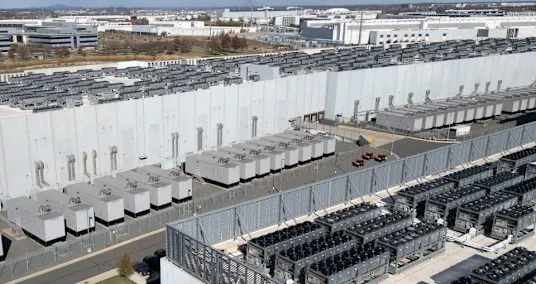
The vast data centers that power artificial intelligence guzzle huge amounts of energy but they also have another alarming impact, according to new research. They are creating “heat islands,” warming the land around them by up to 16 degrees Fahrenheit, and making life hotter for more than 340 million people.
There are still big gaps in our understanding of the impacts of data centers, even as they boom in number, said Andrea Marinoni, associate professor with the Earth Observation group at the University of Cambridge, and an author of the study, which has not yet been peer-reviewed.
Marinoni and his colleagues decided to dig into one under-researched impact: the heat they release through their energy-intensive processes, including computation and powering cooling systems.
To do this, they looked at temperature data over the last 20 years from remote sensors and mapped it against the locations of AI “hyperscalers” — vast data centers that house thousands of servers and can stretch over a million square feet, which have mostly been built within the last decade.
They focused on more than 6,000 data centers located away from highly dense urban areas, as surface temperatures around these were less likely to have been affected by other factors, such as manufacturing or the heating of homes. The researchers also filtered out seasonal impacts, global warming trends and other influences.
They found surface temperatures increased by an average of 3.6 degrees Fahrenheit after a data center started operations. In extreme cases, nearby temperatures reached up to 16.4 degrees Fahrenheit.
These increases were consistent across the globe, the researchers found. In Mexico’s Bajio region, for example, which has become a data center hub, the study found unexplained temperature rises of around 3.6 degrees over the last 20 years. A similar situation was seen in Aragon, Spain, a European center for hyperscale AI data centers, which recorded a temperature increase of 3.6 degrees which was not replicated in neighboring provinces.
Strikingly, the impacts weren’t limited to a data center’s immediate surroundings; temperature increases affected areas up to 6.2 miles away, the research found, affecting more than 340 million people.
The findings are particularly alarming, the scientists say, because AI data centers are set to boom over the next few years, and these temperature rises come as planet-warming pollution is already making heat waves more extreme around the world.
The planned scale up of data centers “could have dramatic impacts on society” in terms of the environment, people’s welfare and the economy, Marinoni said.
Deborah Andrews, emeritus professor of design for sustainability and circularity at London South Bank University, who was not involved in the research, said there are plenty of concerns over the impacts of data centers but this was the first paper she’d seen focusing on the heat they produce.
“The ‘rush for AI-gold’ appears to be overriding good practice and systemic thinking,” she said, “and is developing far more rapidly than any broader, more sustainable systems.”
Marinoni wants the research to spark more discussion about how to reduce AI’s impacts. “There still might be time to consider the possibility of a different path … without affecting the demand of AI and its ability to provide progress for mankind,” he added.
For more CNN news and newsletters create an account at CNN.com
latest_posts
- 1
 New Year's superstitions: Eating 12 grapes, avoiding laundry and other rituals that are said to bring good fortune
 - 2Some super-smart dogs can pick up new words just by eavesdropping
- 3The Specialty of Cleaning up: Change Your Space and Brain
- 4'All Her Fault' ending explained: The shocking conclusion to the psychological thriller inspired by true events
- 5See tonight’s solar storm unfold across the world


- Pick Your #1 breakfast food
- Doctors seek to understand why quitting antidepressants causes withdrawal for some
- Court clears Beersheba assault suspect of link to Haymanut Kasau disappearance, extends detention
- NASA's Artemis 2 moon launch may be visible from Florida and southern Georgia today. Here's when to look
- Misjudged Objections For Solo Voyagers
- Trump says Venezuela will start 'turning over' oil to the U.S. Is that the reason he toppled Maduro — or is it something else?
- Songbirds swap colorful plumage genes across species lines among their evolutionary neighbors
- A definitive Manual for Internet Mastering and Expertise Improvement
- Understanding Successful Compromise Standards to Cultivate Agreeable Connections