Protests took place in Tel Aviv, Jerusalem, Haifa, and Beersheba, as a survey found broad but uneven support among Jewish Israelis for Operation Roaring Lion.
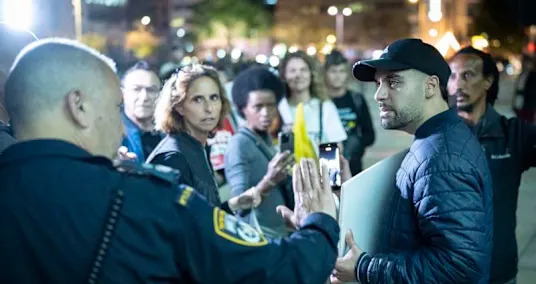
Israel Police arrested 21 anti-war protesters Saturday night as demonstrations against the conflict with Iran expanded in multiple cities despite restrictions on public gatherings.
Protests took place in Tel Aviv, Jerusalem, Haifa, and Beersheba, with hundreds of participants reported in Tel Aviv and Jerusalem and about 100 in Haifa, marking the largest turnout since weekly demonstrations began. Authorities said 13 people were arrested in Tel Aviv and eight in Haifa.
Police said the gatherings were not approved under Home Front Command regulations that ban events with more than 50 people. Officials said the increase in turnout followed calls by groups opposing the government to protest despite the restrictions.
“During a situation assessment that took place at the scene with a Home Front Command representative… it was clarified that there was a real risk to human life and accordingly, Yarkon [precinct] police commander Tzachi Sharabi ordered the gathering to be dispersed,” police said.
Hadash-Ta’al chairman Ayman Odeh, an Arab lawmaker involved in the protests, criticized the police response, calling officers fascists “in the service of the government” and saying they were afraid of “the heroic citizens who went out, despite everything, to make their voice heard.”

Survey shows broad, uneven support for war
The demonstrations come as a March 2026 survey by the Israel Democracy Institute found broad but uneven support among Jewish Israelis for Operation Roaring Lion. Support was strongest on the Right at 87% and about half on the Left.
The survey also found that Jewish and Arab respondents largely agreed that Iran’s resilience has been stronger than expected. Most Jewish respondents said Israeli society could sustain the campaign for up to one month, while 28% said as long as needed. Arab respondents were less optimistic about how long the public could endure the conflict.
A majority of Jewish respondents said Prime Minister Benjamin Netanyahu’s decision was driven by security considerations, while most Arab respondents viewed it as political.
latest_posts
- 1
 23 Most Amusing Messages At any point Sent Among Youngsters and Their Folks
 - 2Potential Houthi threat to Red Sea shipping could further damage global economy
- 3Cyclone causes blackout, flight chaos in Brazil's Sao Paulo
- 4Passover under fire: Israelis balance fatigue with cautious hope after month of war
- 55 Fundamental Ways to employ a Criminal Legal counselor



- Iran-backed militias reassert power in Iraq, proving the Islamic axis is still standing
- Australia PM tries to reassure public as panic buying sees fuel demand surge 400% in some regions
- How did humans evolve, and will we evolve more?
- From ‘Project Hail Mary’ to Artemis II, spaceflight captures audiences when it centers on people because human space travel is hazardous
- New 'People We Meet on Vacation' trailer teases Poppy and Alex romance: Everything we know about the new Netflix movie
- Kidneys from Black donors are more likely to be thrown away − a bioethicist explains why
- Artemis 2 astronaut Victor Glover delivers inspiring Easter message on the way to the moon (video)
- EU delays signing of Mercosur free trade deal
- Bruno Mars tour 2026: How to get tickets for 'The Romantic Tour,' presale times, prices and more